
From roots to leaves, we study the traits that enable plants to survive drought, frost, fire, and competition, and leverage these adaptations to restore wild landscapes in a changing world.

Daniel C. Laughlin, Professor
Louis and Terua Williams Professor
University of Wyoming, Department of Botany
Subject Matter Editor, Ecology
Fellow, Ecological Society of America
New book
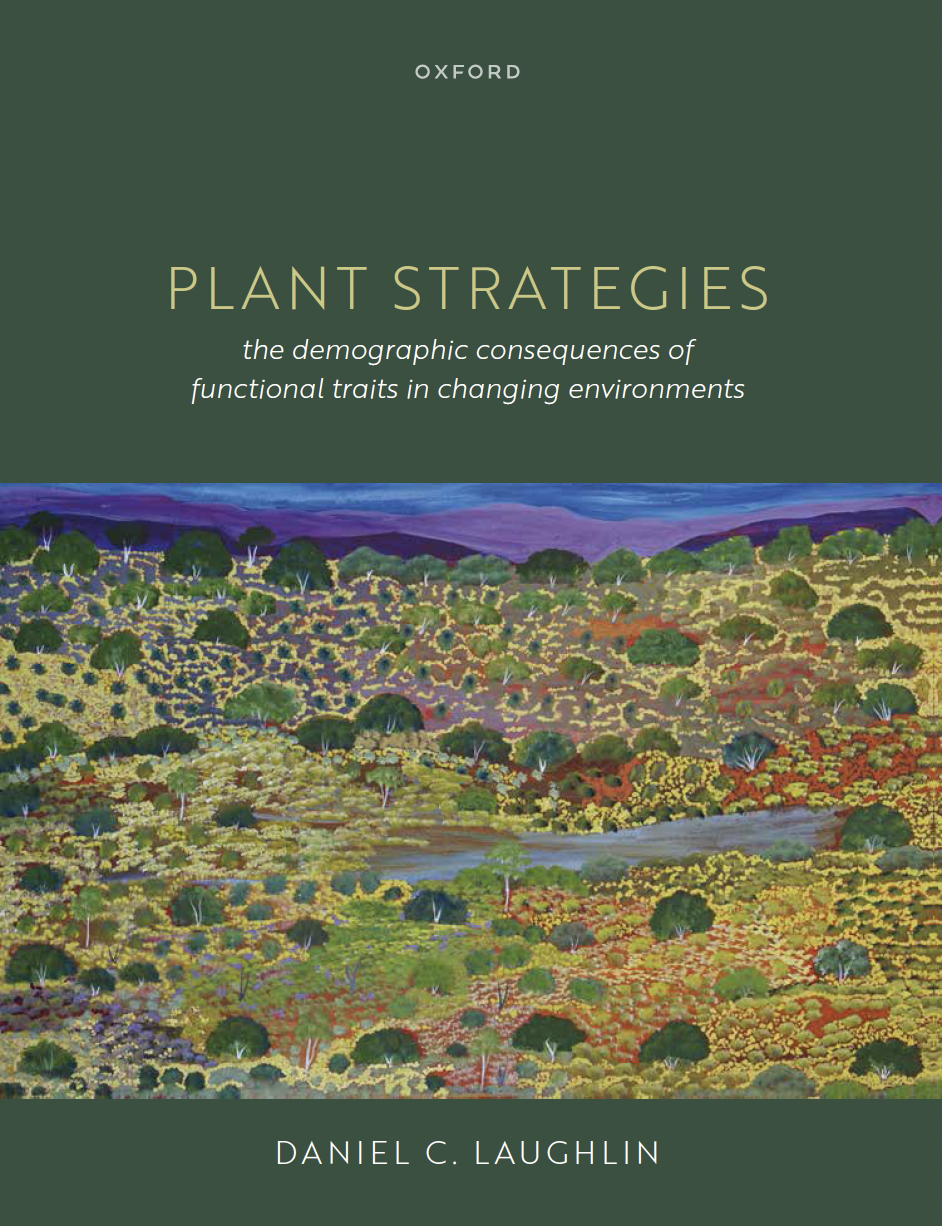
Plant Strategies: The Demographic Consequences of Functional Traits in Changing Environments
Daniel Laughlin, 2023, Oxford University Press
Note to listeners: these were recorded with one take and are not perfect, please excuse the occasional garbled word. These chapter summaries are like cliff notes for the real chapters meant as road maps to the topics explored at depth in the book.
- Title Page and Epigraph
- Preface
- Prologue
- Summary of Part I. Foundations Chapter 1: Perspectives on Plant Strategies · Chapter 2: A Menagerie of Plant Strategy Models · Chapter 3: The Dimensionality of Plant Strategy Theory
- Summary of Part II. Demography and Life History Chapter 4: Plant Demography · Chapter 5: Life History Theory Applied to Plants
- Summary of Part III. Comparative Functional Ecology Chapter 6: Plant Functional Traits and the Multidimensional Phenotype · Chapter 7: Plant Strategies Along Resource, Disturbance, and Temperature Gradients
- Summary of Part IV. The Net Effect of Traits on Fitness Chapter 8: Empirical Approaches to Infer Fitness from Traits · Chapter 9: Game Theoretical Approaches to Infer Fitness from Traits · Chapter 10: Applying Plant Strategies in Conservation and Restoration
- Summary of Part V. The Effect of Traits on Demographic Rates Chapter 11: Plant Traits that Promote Growth and Enhance Survival · Chapter 12: Plant Traits that Bolster Recruitment
- Epilogue